 Bootstrapped
By the end of this you'll have a price for your own product: the model, the floor, the ceiling, the chunk people buy, and ten people's answers to the number.
You'll walk it on a real app first, layer by layer, then do the same on yours.
In 60 seconds
- The digit is rarely the problem. The starting price isn't what separates earning products from ones at $0; the model and the offer are.
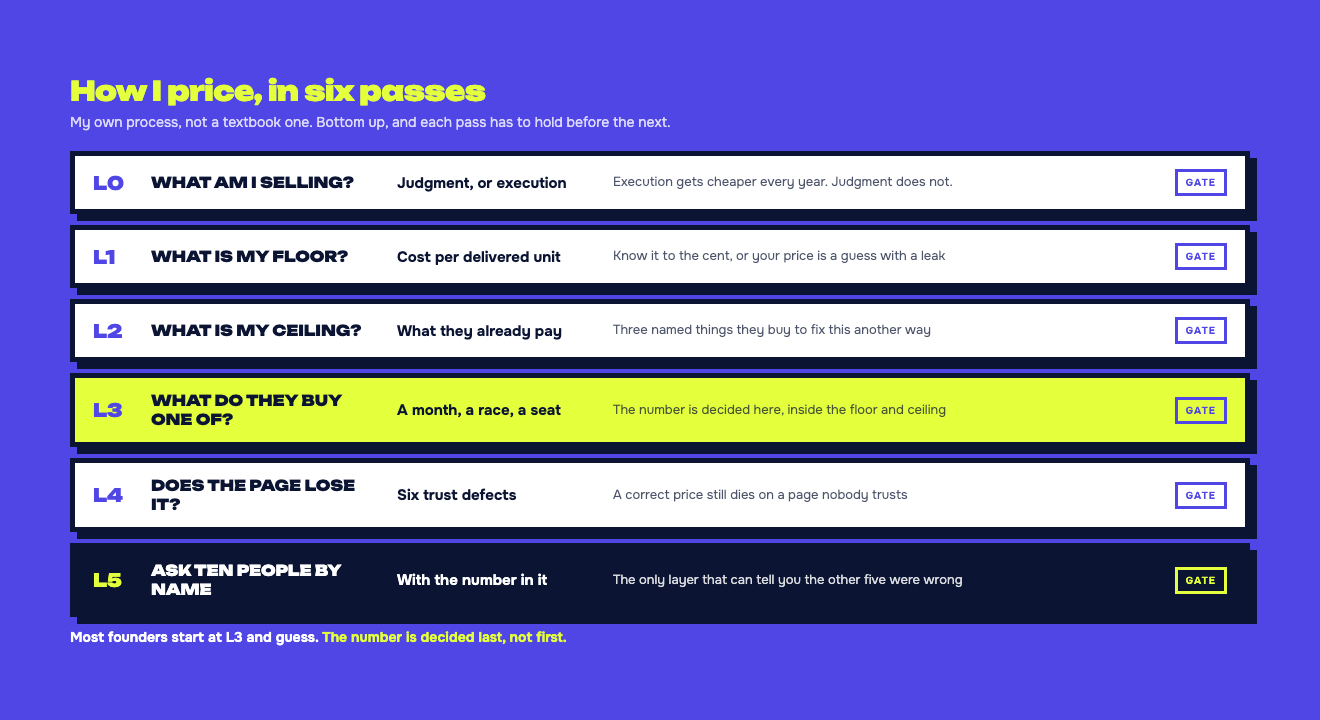
- Six layers, bottom up, each with a gate: what you sell, your floor, their ceiling, the chunk, the page, and real people saying yes.
- Change seats halfway. Your floor never closed anybody. Say the return in the buyer's own unit: "four extra customers and it has paid for itself".
- Make it hard to say no: lower the risk, shorten the time to the result, make it easy. That's what turns a price into an offer.
Step 1: Pick the model before the number
15 minutes
Before any digit, decide how people pay. Across small SaaS with verified revenue (TrustMRR, Sept 2026), the model separates the ones earning from the ones at $0 far more than the price does.
| Earning | At $0 | |
|---|---|---|
| Subscription | 75% | 61% |
| One-time or lifetime | 4% | 18% |
| Card-required free trial | 13% | 6% |
| A yearly plan offered | 66% | 38% |
| A free tier | 60% | 66% |
Default: monthly, a yearly plan from day one, and any trial short, with the card up front. A free tier alone doesn't help.
Warning. Correlations, not proof: yearly plans get added as products age. A default, not a law.
Done when: you've written down your model: monthly, yearly, and whether there's a trial.